By Ashutosh Raj
Published: April 22, 2026 | Updated: April 22, 2026
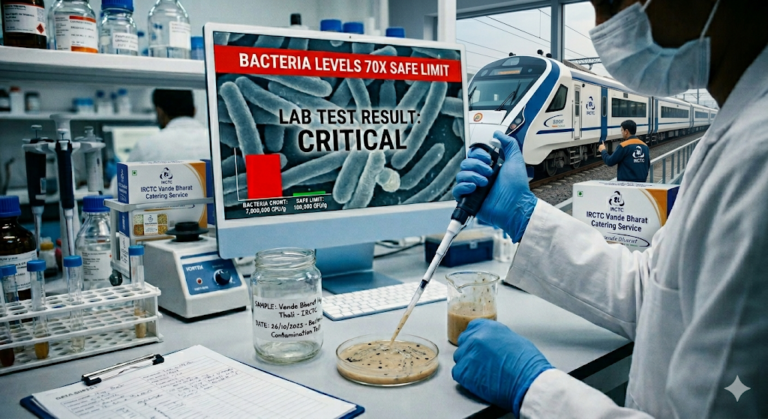
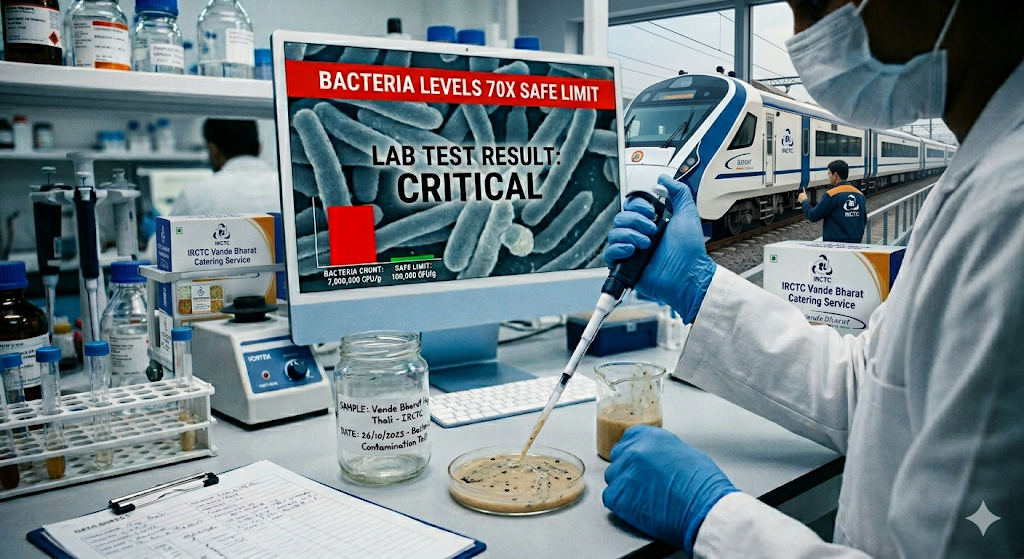
Food served on premium trains has again come under public scrutiny after an independent laboratory-based review of a vegetarian meal supplied on a Vande Bharat Express route reported bacterial levels above accepted food-safety limits in multiple cooked items. The test, conducted through a blind-sampling process by Trustified, focused on a standard IRCTC veg thali collected directly from the train and transported under controlled temperature conditions before laboratory analysis. What makes the report significant is not only that some items failed microbiological parameters, but that the highest bacterial load appeared in foods passengers generally consider safest because they arrive hot and freshly packed.
The tested thali included dal, jeera rice, paneer curry, dry vegetable, curd and roti. According to the laboratory findings shared in the test report, heavy metal and aflatoxin screening did not raise major concerns in most items. The more serious issue appeared in microbiological analysis, where cooked components showed bacterial counts that exceeded accepted limits by wide margins. Jeera rice showed Enterobacteriaceae levels reported at nearly seventy times the safe threshold, while dal recorded roughly fifty times above the same limit. Paneer gravy showed multiple failures across different bacterial indicators, making it the most concerning item in the overall meal profile.
To understand why this matters, it is important to separate chemical contamination from hygiene contamination. Heavy metals and aflatoxins usually indicate long-term ingredient quality issues or raw material contamination. Bacterial overload, by contrast, usually points toward operational handling problems after cooking such as delayed sealing, poor holding temperature, contaminated serving surfaces, repeated exposure during packaging, or interrupted hot-chain management between kitchen and passenger delivery.
The strongest warning sign in the report is the presence of Enterobacteriaceae, a bacterial family often used globally as a hygiene indicator in cooked food systems. Its presence at elevated levels does not automatically mean severe infection in every case, but it strongly suggests that food handling conditions somewhere between preparation and serving were compromised. In practical food safety systems, high Enterobacteriaceae counts usually trigger inspection because they often indicate cross-contact from hands, utensils, storage trays, water contact points, or surfaces not sanitised properly after repeated use.
Dal, which many passengers consider a low-risk cooked item because it is boiled at high temperature, also failed hygiene testing. This usually means contamination likely happened after cooking rather than during cooking itself. A properly boiled lentil dish should naturally suppress most microbial growth at preparation stage, so high bacterial counts later often indicate exposure during ladling, packaging, holding or delayed service under unsafe temperatures.
The paneer gravy raised a more complex concern because multiple bacterial markers appeared together. The report described elevated APC, E. coli, Bacillus cereus and Enterobacteriaceae counts. When several microbiological markers appear in one cooked dairy-based dish, food safety experts usually look first at temperature retention failures because paneer-based gravies become highly sensitive once cooling begins. If a cooked dairy item remains for too long in the danger temperature zone—roughly between 5°C and 60°C bacterial multiplication can accelerate rapidly.
One detail often missed in public reactions is that curd actually passed microbiological testing. That result matters because curd spoils quickly if transport temperature fails badly. Since curd remained within acceptable range, it suggests the sample likely reached the laboratory in a stable controlled state. That weakens the argument that contamination happened after collection and instead points attention back toward earlier kitchen or onboard handling stages.
Roti also passed all tested categories, including microbiological parameters. This contrast is important because dry foods with lower moisture content naturally offer less bacterial growth opportunity compared with semi-liquid dishes like dal or gravy. In food safety analysis, moisture-rich cooked foods almost always become the first risk point if hygiene systems weaken even briefly.
The broader issue is not only one meal report but the operational chain behind train catering. A meal served on premium rail routes usually passes through several stages: central kitchen cooking, batch packing, transport loading, train pantry handling, distribution timing and passenger delivery. A single weak point in that chain can affect food quality even if the kitchen itself begins under acceptable conditions.
Recent public concern around railway food has already increased after viral videos showed questionable cleaning practices and passenger complaints involving packaged dairy products and pantry hygiene. Independent testing gains attention in that context because it attempts to move discussion from social media claims to measurable laboratory indicators. Still, one sample alone cannot define every meal served across the railway network. What it can do is highlight where stronger batch audits become necessary.
Serious Health concern issue
From a public health perspective, bacterial overload at these levels may not affect every passenger equally, but vulnerable groups face higher risk. Children, elderly passengers, those with weak digestion, or people already dehydrated during long journeys can react faster to contaminated cooked food. Symptoms linked to such exposure commonly include nausea, stomach cramps, loose motion, vomiting and fatigue within hours depending on bacterial type and individual tolerance.
A larger food safety lesson also emerges here: premium branding does not automatically guarantee microbiological safety. Vande Bharat is marketed as a flagship passenger experience, but food hygiene depends less on branding and more on invisible discipline clean ladles, hot holding temperature, hand hygiene, sealed transfer systems and controlled service intervals.
For passengers, carrying home-packed food remains the safest option on long routes, especially when travelling with children or during summer. For railway catering systems, the bigger challenge is trust. Once laboratory findings enter public discussion, confidence returns only when repeat testing, transparent audits and corrective action become visible rather than promised.
The real test now is not whether one report trends online, but whether food served across premium train routes undergoes regular independent microbiological checks that passengers can trust before the next meal reaches another tray table.
About the Author
Ashutosh Raj is a journalist and independent writer known for clear, fact-based reporting and sharp editorial judgment. His work focuses on delivering accurate information with original analysis, structured storytelling, and strong attention to credibility. He writes with a commitment to clarity, relevance, and meaningful public understanding.
About the Author