By Ashutosh Raj
Published: April 14, 2026 | Updated: April 13, 2026
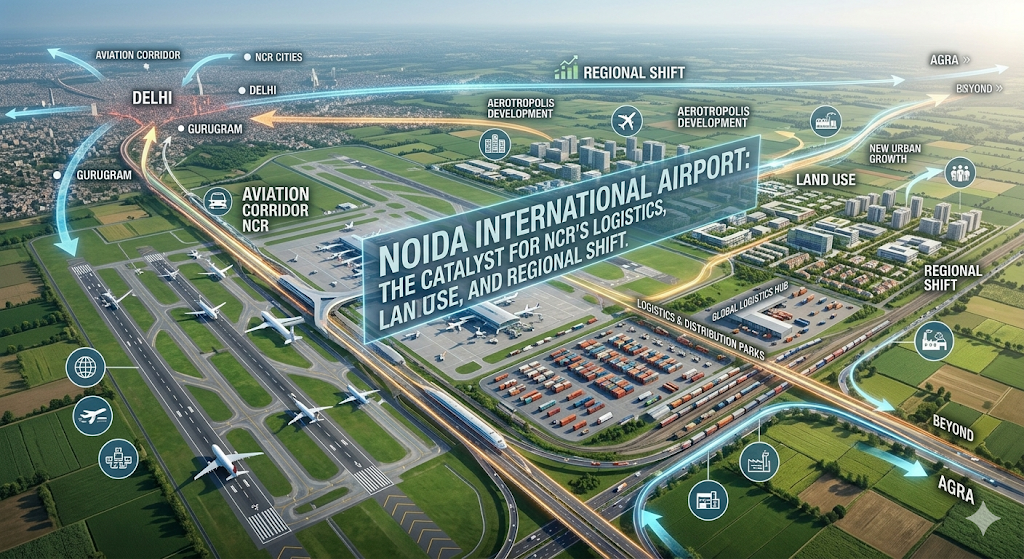
The inauguration of Noida International Airport has added a second major international gateway to the Delhi-NCR aviation network, but the long-term significance of the project goes beyond adding another runway near the capital. Prime Minister Narendra Modi formally opened Phase I of the airport on 28 March, launching a project designed to eventually handle traffic at a scale that could alter how northern India distributes passenger movement, cargo operations and industrial investment. Phase I was built with an investment of around ₹11,200 crore and begins with one terminal and one runway, while commercial operations are expected to expand in stages after regulatory clearances and airline scheduling stabilise.
The immediate headline around the airport has focused on congestion relief for Indira Gandhi International Airport, which currently handles one of the heaviest passenger loads in the country. That part is true, but the deeper operational reason Jewar matters is slot pressure. Delhi’s existing airport already manages dense traffic windows, especially during morning and evening peaks, which limits flexibility for airlines trying to add new domestic sectors or low-cost connections. By creating another high-capacity airport within the same regional demand belt, planners are effectively building a dual-airport system where future traffic can be distributed instead of forcing all expansion into one already crowded airspace.
Phase I starts with capacity for roughly 12 million passengers annually, slightly above the often-cited one crore estimate because airport planning counts usable terminal throughput rather than rounded public figures. What matters more is scalability. Later phases are structured so the airport can rise to 30 million passengers and eventually approach 70 million annually by the final development stage. At full scale, the project is planned across several thousand hectares, making it one of the largest long-term airport developments in Asia by land footprint.
A detail often missed in regular reports is that airport economics in Jewar may be shaped more by freight than by passengers during the early years. The cargo plan begins with an annual handling target of about 250,000 metric tonnes, but the larger design pushes toward 1.8 million tonnes over later phases. That matters because western Uttar Pradesh already sits near major manufacturing belts, electronics clusters, food processing corridors and expressway-linked warehousing zones. For exporters, especially those moving time-sensitive goods, cargo proximity often matters more than passenger convenience.
This is where location becomes strategic. Jewar sits near the Yamuna Expressway and connects into freight movement corridors that can reach Agra, Mathura, Aligarh and industrial stretches of Greater Noida without forcing every shipment through Delhi’s urban bottlenecks. In practical logistics terms, reducing one truck’s turnaround time by even a few hours changes warehouse economics at scale. That is why airport-linked land values usually rise before full passenger maturity arrives.
Another under-discussed layer is maintenance infrastructure. The airport includes a dedicated MRO ecosystem—maintenance, repair and overhaul—which can reduce airline dependence on distant engineering hubs. In aviation economics, an airport with MRO support becomes more attractive because aircraft downtime costs airlines heavily. If that ecosystem matures properly, Jewar may become useful not just as a departure point but as a technical service location for fleets operating across north India.
Architecturally, the terminal has also been designed around low-energy operating goals rather than only visual scale. The terminal design targets carbon-conscious operation, natural light use and reduced internal heat load. While many airport projects advertise sustainability, Jewar’s design matters because large terminals usually struggle with cooling efficiency in north Indian summer conditions. If the building performs as planned, operating costs can stay lower over time than conventional glass-heavy terminals.
Yet the airport still faces a practical challenge that many celebratory reports underplay: surface access remains more road-dependent than ideal in its opening stage. Metro and regional rail integration are planned, but until those systems become fully operational, passenger convenience will depend heavily on road travel time, which changes sharply depending on origin. A traveller from central Delhi may still find travel time significant, while western Uttar Pradesh users may gain the most immediate advantage.
That uneven benefit explains why the airport could reshape regional development faster than airline behaviour. Land around major airports often attracts hotels, logistics parks, convention facilities and industrial investment before passenger numbers fully mature. In Jewar’s case, that process is already tied to nearby warehousing plans, proposed film city development and expressway-linked commercial projects.
For ordinary travellers, the airport initially looks like another departure option. For planners, it is much bigger: a long-term redistribution of where economic gravity in NCR may shift over the next decade. If cargo scales quickly, road links improve on schedule and airlines build competitive routes, Jewar may influence not just how people fly, but where businesses choose to grow across western Uttar Pradesh.
About the Author
Ashutosh Raj is a journalist and independent writer known for clear, fact-based reporting and sharp editorial judgment. His work focuses on delivering accurate information with original analysis, structured storytelling, and strong attention to credibility. He writes with a commitment to clarity, relevance, and meaningful public understanding.
About the Author