By Ashutosh Raj
Published: April 13, 2026 | Updated: April 13, 2026
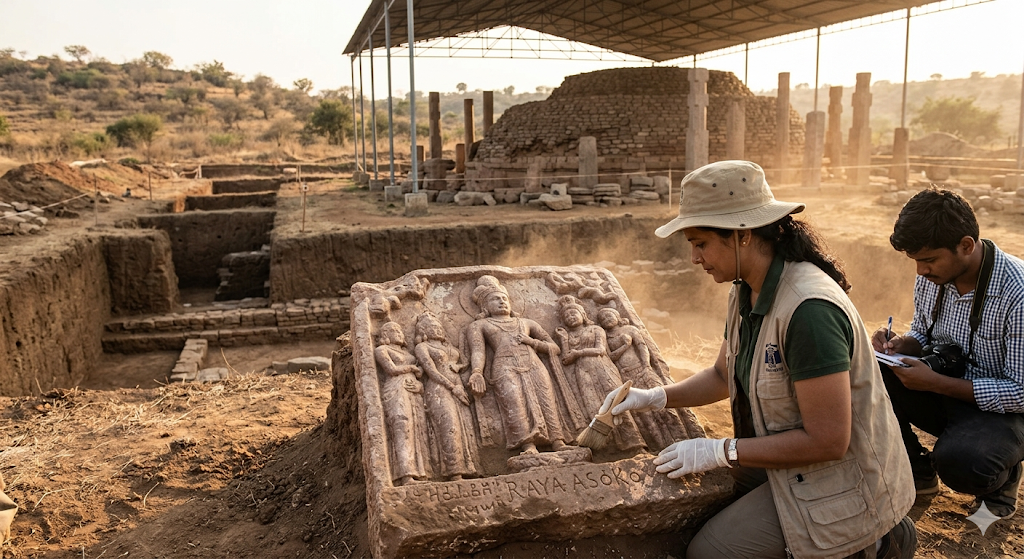
A rare sculptural image linked to Emperor Ashoka continues to draw attention from historians because it offers something his famous inscriptions never fully did: a visual representation of the ruler himself. At the archaeological site of Kanaganahalli near Sannati in Karnataka’s Kalaburagi district, excavators uncovered a carved limestone panel showing a royal figure identified through inscription as “Raya Asoko,” widely read as “King Ashoka.” The relief is especially important because it is regarded as the only known inscribed sculptural portrait of Ashoka discovered so far.
The panel was found during excavation work led by the Archaeological Survey of India after systematic digging began in the wider Sannati–Kanaganahalli zone in the late 1980s and expanded through the 1990s. Archaeologists were initially studying Buddhist remains in the area when they uncovered the remains of a large stupa complex along with hundreds of sculpted limestone fragments, inscriptions, railings and narrative panels. Among these fragments, the Ashoka panel immediately stood out because the inscription removed uncertainty over identity, something rare in ancient Indian royal art.
What makes the sculpture historically valuable is that Ashoka is usually known through stone edicts, pillars and administrative inscriptions spread across the subcontinent rather than through labelled portraits. His political voice survived in rock and pillar texts where he described moral governance, non-violence, administrative duty and welfare measures after the Kalinga War changed the direction of his rule. Yet visual depictions directly tied to his name are extremely uncommon, which is why the Kanaganahalli find is treated as a major interpretive source rather than just another archaeological object.
The relief itself is believed to show Ashoka seated in royal posture with female attendants or queens nearby, reflecting courtly symbolism rather than battlefield authority. Scholars note that this is important because Mauryan imperial representation usually survives through symbols such as lions, wheels and inscriptions rather than domestic royal imagery. In practical terms, the sculpture gives historians clues about how later Buddhist communities remembered Ashoka: not only as a ruler, but as a patron connected to sacred sites and ceremonial authority.
Kanaganahalli is equally important because the Ashoka portrait was not found in isolation. Excavations revealed a massive Buddhist mahastupa dating roughly between the first century BCE and third century CE, meaning much of the visible sculptural program belongs to a later period than Ashoka himself. This suggests that communities centuries after the Mauryan empire still considered him central enough to include in monument decoration. In archaeology, that matters because it shows historical memory surviving long after direct political rule ended.
The stupa’s remains also contain inscriptions naming donors, monks and regional patrons, which helps researchers understand how Buddhism expanded through southern India beyond the Mauryan core territories. While northern sites such as Sanchi often dominate public discussion, Kanaganahalli shows that southern Deccan centres also developed rich sculptural traditions linked to Buddhist patronage, trade routes and regional dynasties including the Satavahanas. This broadens the historical map of early Indian religious architecture.
Another reason the site matters is language. The inscription identifying Ashoka is written in Brahmi script, one of the earliest writing systems used across much of ancient India. For historians, such inscriptions are critical because names in ancient reliefs are often missing, damaged or debated. Here, the written label sharply strengthens interpretation, reducing speculation that usually surrounds royal identifications in early art.
The site also connects to a wider Karnataka historical network. Ashokan inscriptions were previously identified in places such as Maski, where one edict became famous because it explicitly used the name Ashoka rather than only imperial titles like Devanampiya. That earlier inscription helped historians firmly connect many anonymous edicts across India to the Mauryan emperor. Kanaganahalli adds visual evidence to that epigraphic chain.
Preservation remains difficult. Many sculptural slabs were discovered broken, displaced or weathered after centuries of exposure and structural collapse. Because large sections of the original stupa had suffered severe damage, archaeologists could conserve and reassemble only parts of the monument rather than fully restore it. That limitation explains why Kanaganahalli remains academically important even if it is less publicly known than some better-preserved heritage sites.
For readers, the deeper lesson from this discovery is that archaeology does more than confirm old history books. It changes emphasis. Ashoka has long been remembered through moral inscriptions and imperial symbols such as the lion capital. Kanaganahalli adds a human layer: a ruler remembered in carved stone by later communities who considered his presence meaningful enough to preserve beside Buddhist architecture in southern India. That makes the site important not only for Mauryan studies, but for understanding how historical memory itself survives across centuries.
About the Author
Ashutosh Raj is a journalist and independent writer known for clear, fact-based reporting and sharp editorial judgment. His work focuses on delivering accurate information with original analysis, structured storytelling, and strong attention to credibility. He writes with a commitment to clarity, relevance, and meaningful public understanding.
About the Author