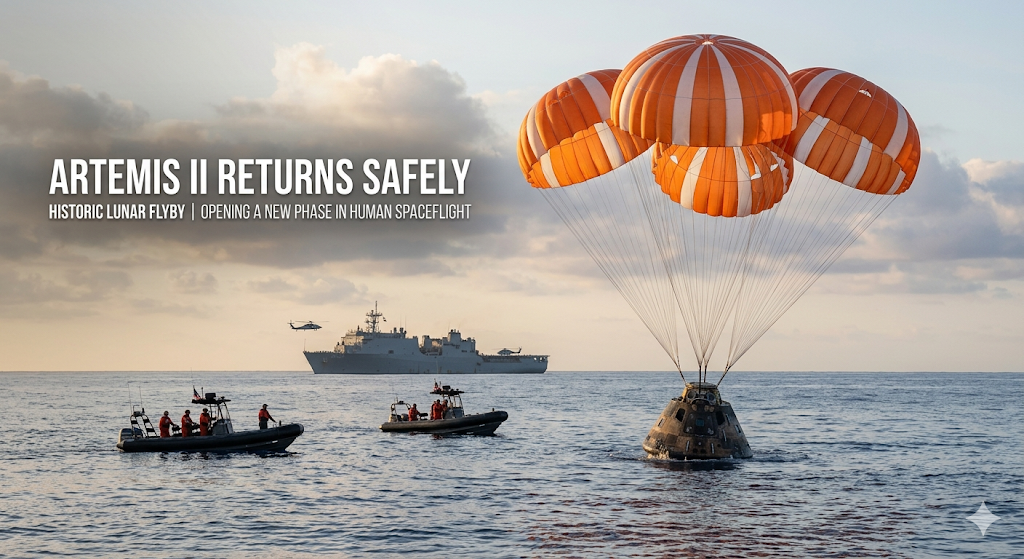
Artemis II Returns Safely After Historic Moon Mission, Opening a New Era of Human Deep-Space Exploration
Humanity’s return to deep-space travel crossed a major milestone after NASA safely brought the Artemis II crew back to Earth following a successful mission around the Moon, ending more than five decades of absence from crewed lunar-distance operations. The Orion capsule splashed down in the Pacific Ocean after completing a journey that space agencies, defense planners and aerospace companies had been watching closely because the mission was far more than a symbolic Moon flyby. It was the first real test of whether modern human deep-space transportation systems can reliably support astronauts beyond low Earth orbit again.
The mission immediately became one of the most important moments in modern spaceflight because no human crew had traveled this far from Earth since the Apollo era ended in 1972. Artemis II carried astronauts more than 400,000 kilometers away before returning home, pushing modern systems into conditions that cannot be fully replicated through simulations or robotic testing alone. Unlike earlier experimental missions focused mainly on proving rockets could fly, this journey examined whether long-duration crew survival systems remain stable under real operational stress.
NASA selected a crew that also reflected changing priorities in modern exploration. Commander Reid Wiseman, pilot Victor Glover, mission specialist Christina Koch and Canadian astronaut Jeremy Hansen formed a team representing broader international and social inclusion compared with earlier lunar missions. The flight marked the first lunar-distance mission carrying a woman, a Black astronaut and a non-American astronaut together beyond low Earth orbit. That matters politically because Artemis is designed as an international framework rather than a purely American prestige project.
The engineering purpose behind Artemis II was even more significant than its symbolism. NASA used the mission to validate life-support performance, radiation exposure behavior, communication reliability, navigation stability and high-speed atmospheric re-entry systems under actual crewed conditions. These tests directly affect future lunar missions because systems that perform well during unmanned trials can still behave differently when humans, long-duration operations and live environmental variables are introduced simultaneously.
One of the most closely monitored stages came during Earth re-entry, when Orion plunged into the atmosphere at extreme speed. Heat shield performance became critical because temperatures during descent rise to several thousand degrees Celsius. NASA engineers had paid particular attention to this phase after earlier technical reviews raised questions regarding thermal protection material behavior. The successful splashdown now removes one of the biggest technical uncertainties standing between current testing and future lunar surface missions.
The geopolitical timing of Artemis II also matters. China has accelerated its own lunar ambitions and publicly signaled plans for a crewed Moon landing before 2030. Chinese space agencies have expanded robotic lunar operations, hardware testing and long-term exploration planning, turning lunar exploration into a strategic competition involving technology leadership, industrial influence and national prestige. Artemis II therefore functions not only as a scientific achievement but also as a demonstration that the United States remains capable of organizing large-scale deep-space missions at operational level.
An important detail often missed in public discussion is how much economic infrastructure now depends on programs like Artemis. Modern lunar missions support enormous supply chains involving propulsion manufacturers, advanced materials companies, aerospace software developers, robotics firms and communications contractors. A major failure could have delayed years of industrial planning and weakened confidence among private partners already investing heavily in lunar technologies. The mission’s success instead strengthens financial and political confidence surrounding future contracts and development timelines.
The broader Artemis strategy extends far beyond a single mission or even a single landing. NASA aims to establish repeated lunar operations, orbital stations, transportation systems and eventually infrastructure capable of supporting sustained human activity near the Moon. Artemis II acts as a bridge between earlier unmanned testing and future operational missions where astronauts will attempt more difficult tasks such as lunar landing precision, habitat management and long-duration surface survival.
For ordinary readers, the importance of space missions can sometimes feel distant compared with daily economic or political concerns. Yet deep-space programs historically influence technologies that later become part of everyday life. Satellite communication, weather forecasting, advanced medical imaging, navigation systems and miniaturized computing all benefited from earlier aerospace research. Future lunar missions may similarly accelerate progress in robotics, energy systems, automation and material engineering.
The successful return of Artemis II therefore represents more than a safe mission ending. It signals that human deep-space exploration has moved beyond theoretical planning and entered a stage where long-term lunar operations are becoming technically achievable again. The next challenge will no longer be whether humans can return near the Moon. It will be whether nations can sustain the enormous political, technological and financial commitment required to stay there permanently.
About the Author
Ashutosh Raj is a journalist and independent writer known for clear, fact-based reporting and sharp editorial judgment. His work focuses on delivering accurate information with original analysis, structured storytelling, and strong attention to credibility. He writes with a commitment to clarity, relevance, and meaningful public understanding.
.
About the Author