India’s Growth Outlook Stays Strong, but Oil Risks and Foreign Investor Pullback Are Testing Economic Stability
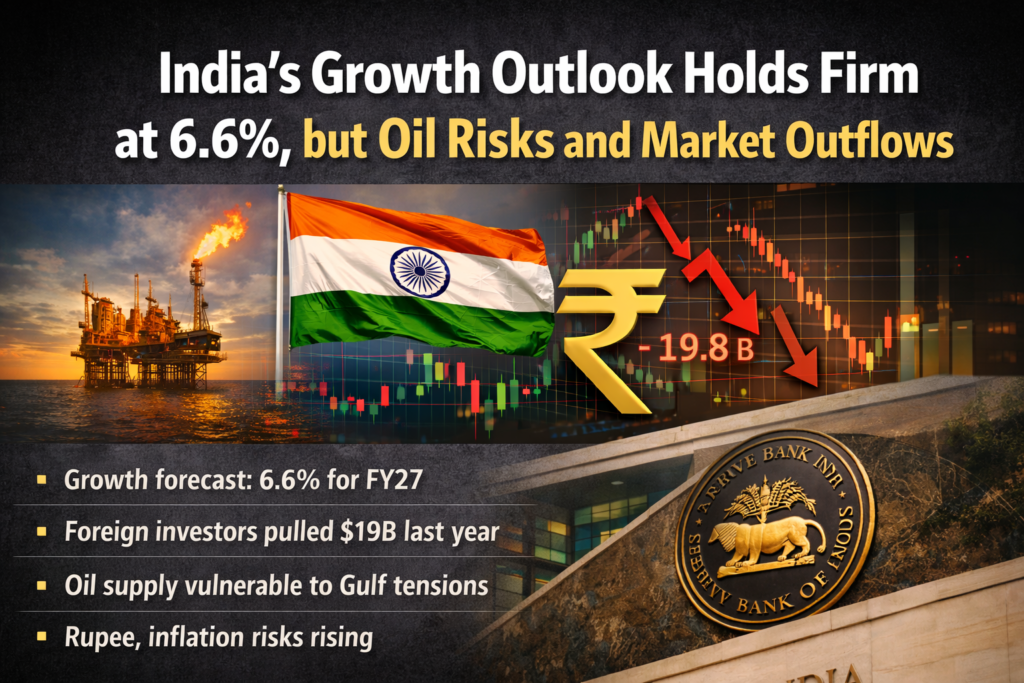
India is entering the next financial cycle with growth momentum still stronger than most major economies, yet the optimism is now being tempered by a different kind of pressure — one that comes not from domestic weakness, but from rising external vulnerability. Fresh projections from the World Bank estimate India’s economy could expand by 6.6% in FY27, supported by resilient domestic demand, public infrastructure spending and relatively stable banking conditions. At the same time, policymakers are increasingly focused on global developments that could rapidly alter the economic picture, particularly energy disruption risks tied to West Asia and sustained foreign capital outflows from Indian financial markets.
The concern is not theoretical. India imports nearly 90% of its crude oil requirements, making the country highly exposed to geopolitical instability around critical shipping corridors such as the Strait of Hormuz. Even a temporary disruption in tanker movement or a sudden rise in crude prices can push transportation costs, logistics expenses and industrial input prices sharply higher within weeks. For an economy still balancing growth and inflation recovery after years of global disruption, energy volatility remains one of the fastest ways external pressure can enter domestic markets.
Recent market behavior suggests investors are already adjusting to that risk. Overseas institutional investors pulled roughly $19 billion from Indian markets during the last financial year, with banking and financial-sector stocks absorbing a significant portion of the selling pressure. March witnessed especially heavy outflows from financial companies, contributing to weakness in benchmark indices and adding downward stress on the rupee. Foreign investors typically reduce exposure when they anticipate currency volatility, higher oil costs or tighter global liquidity conditions.
That currency angle has quietly become one of the most important parts of the current economic story. The Reserve Bank of India recently tightened rules related to banks’ foreign exchange exposure, prompting several institutions and market participants to unwind large rupee arbitrage positions before the regulatory deadline. While the move was aimed at reducing speculative risk and strengthening long-term financial discipline, it also increased short-term caution across currency markets. Traders and treasury desks have become more defensive as uncertainty around external capital movement grows.
Despite those pressures, inflation has remained relatively contained so far. Economists surveyed ahead of recent data releases estimated consumer inflation near 3.48% for March, staying below the RBI’s medium-term target range. Stable food prices have played a major role in preventing sharper inflation spikes. That matters because food inflation carries immediate political and household consequences in India, where even moderate increases in daily essentials quickly affect lower- and middle-income families.
The larger danger lies in delayed fuel transmission. Retail fuel prices do not always reflect global crude changes immediately because oil marketing companies and government policy often smooth price movement over time. Yet if international crude prices remain elevated for a prolonged period, pressure eventually reaches consumers through transportation, manufacturing and service costs. This gradual pass-through effect is one reason economists closely monitor imported inflation rather than focusing only on current retail data.
One important detail often overlooked in discussions around India’s growth story is the role public infrastructure spending now plays in maintaining economic momentum. Roads, freight corridors, rail modernization, logistics parks and urban transport projects have become major demand drivers over the last several years. Private investment recovery has improved, but government capital expenditure still acts as a stabilizing engine when external conditions weaken. Internal policy reviews suggest authorities are unlikely to reduce infrastructure spending aggressively even if commodity pressure intensifies because slowing those projects could weaken broader growth confidence.
The global context also matters. Many advanced economies continue to struggle with slower growth, aging populations and manufacturing slowdown. India’s comparatively young workforce, expanding digital economy and rising consumption base still make it one of the more attractive long-term growth markets. That relative strength explains why global institutions continue projecting stronger Indian expansion even while warning about external shocks.
For ordinary citizens, the effects of these macroeconomic shifts may appear indirectly at first. Currency pressure can increase prices of imported electronics, industrial goods and fuel-linked services. Businesses facing higher logistics costs may pass expenses to consumers gradually rather than immediately. Loan rates, transport fares and manufacturing margins can all shift over time depending on oil stability and foreign capital conditions.
There is also a broader educational lesson hidden inside the current situation. Fast-growing economies are not automatically insulated from global instability. In highly interconnected systems, trade routes, energy markets, currency flows and investor sentiment can influence domestic prices and growth almost as strongly as local policy decisions. India’s challenge now is not simply maintaining growth, but doing so while reducing exposure to imported shocks that remain outside direct domestic control.
The coming financial cycle may therefore test how effectively India can balance strong internal demand with rising external uncertainty. The foundation of growth remains intact, but the margin for policy error is becoming narrower as global energy and capital markets grow more unpredictable.
About the Author
Ashutosh Raj is a journalist and independent writer known for clear, fact-based reporting and sharp editorial judgment. His work focuses on delivering accurate information with original analysis, structured storytelling, and strong attention to credibility. He writes with a commitment to clarity, relevance, and meaningful public understanding.
About the Author