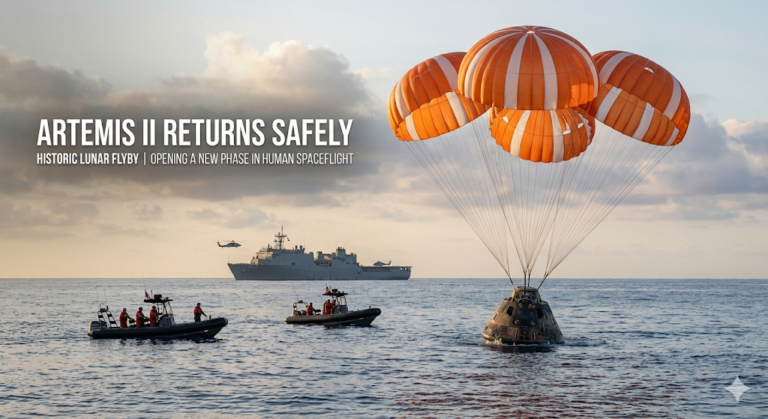
Artemis II Marks Humanity’s Return to Deep Space as NASA Prepares First Crewed Moon Mission Since Apollo Era
More than five decades after astronauts last traveled beyond Earth’s orbit toward the Moon, NASA is preparing to send humans back into deep space through the Artemis II mission, a project that carries scientific ambition, geopolitical pressure and enormous financial expectations all at once. The upcoming flight will not land on the lunar surface, but its importance inside the global space industry is difficult to overstate. Artemis II represents the first crewed mission designed to push astronauts beyond low-Earth orbit since Apollo 17 ended the original Moon era in 1972.
The mission is expected to place four astronauts aboard NASA’s Space Launch System rocket and the Orion spacecraft for a roughly 10-day journey around the Moon. The crew includes NASA astronauts Reid Wiseman, Victor Glover and Christina Koch, along with Canadian astronaut Jeremy Hansen, who is set to become the first non-American to participate in a lunar mission under the modern Artemis framework. Their spacecraft will travel thousands of kilometers beyond the Moon before returning to Earth, testing systems that NASA hopes will eventually support sustained lunar operations and future Mars missions.
This moment matters now because the global space race has changed dramatically since the Cold War. During the Apollo era, the United States and the Soviet Union competed primarily for political symbolism and technological prestige. The Artemis era is unfolding in a far more commercially connected environment where space exploration is linked to national security, satellite dominance, private aerospace investment and long-term control over future lunar infrastructure. China’s rapid progress in robotic lunar exploration and its stated goal of sending astronauts to the Moon before 2030 has intensified pressure on the United States to accelerate its own timeline.
The financial scale of Artemis reflects those ambitions. NASA’s Artemis program has accumulated costs estimated at around $93 billion since development began in 2012. Critics argue the budget is difficult to justify during periods of economic strain and rising domestic priorities. Supporters counter that major space programs historically generate technological breakthroughs far beyond rockets themselves. Innovations tied to previous NASA programs eventually influenced computing, telecommunications, medical imaging and advanced manufacturing industries. Artemis supporters believe lunar exploration could trigger another wave of commercial technology development over the next two decades.
One important detail often missed in public discussion is that Artemis is not designed as a short-term flag-planting mission. NASA is attempting to build an operational system around the Moon rather than simply repeat Apollo-style visits. Future missions are expected to involve lunar landers, orbiting support stations, cargo delivery systems and potentially permanent infrastructure for research and industrial activity. In practical terms, Artemis is closer to the early construction phase of a transportation network than a symbolic exploration stunt.
The Orion spacecraft itself carries major significance. NASA already tested the capsule during the uncrewed Artemis I mission in 2022, where it successfully traveled around the Moon and returned safely to Earth. Artemis II will now test whether the spacecraft can safely support astronauts during long-duration deep-space operations, including radiation exposure, communication delays and life-support stability. These conditions become increasingly important as missions move farther from Earth’s protective environment.
The crew selection also reflects changing priorities in modern space exploration. Christina Koch is expected to become the first woman to travel to the Moon’s vicinity, while Victor Glover will become the first Black astronaut assigned to a lunar mission. Jeremy Hansen’s inclusion highlights how international partnerships are becoming more central to large-scale exploration programs. Unlike Apollo, which was overwhelmingly American in structure, Artemis is gradually evolving into a multinational strategic alliance involving governments and private aerospace companies.
Private industry is expected to play an even larger role in future phases. NASA plans for Artemis III and later missions include partnerships with companies such as SpaceX and Blue Origin, both of which are developing lunar landing systems. This model represents a major shift in how exploration is funded and managed. Instead of government agencies controlling every stage directly, NASA is increasingly functioning as a coordinator between public science goals and commercial aerospace capability.
For ordinary people, the importance of Artemis may seem distant compared with everyday concerns on Earth. Yet space infrastructure quietly affects modern life far more than most realize. GPS navigation, weather forecasting, banking synchronization, disaster monitoring and communication networks all depend heavily on technologies shaped by space research. Future lunar systems could influence mining technologies, energy storage, robotics and advanced communication systems in ways that eventually reach civilian economies.
The launch from Kennedy Space Center will therefore symbolize more than another rocket test. Artemis II stands at the intersection of science, politics, economics and human ambition. If the mission succeeds, it could redefine how nations cooperate and compete beyond Earth while laying the foundation for the first sustained human presence around the Moon in modern history.
About the Author
Ashutosh Raj is a journalist and independent writer known for clear, fact-based reporting and sharp editorial judgment. His work focuses on delivering accurate information with original analysis, structured storytelling, and strong attention to credibility. He writes with a commitment to clarity, relevance, and meaningful public understanding.
About the Author