China’s ShengShu Secures Major AI Funding as Race Shifts Beyond Chatbots Toward Real-World Machine Intelligence
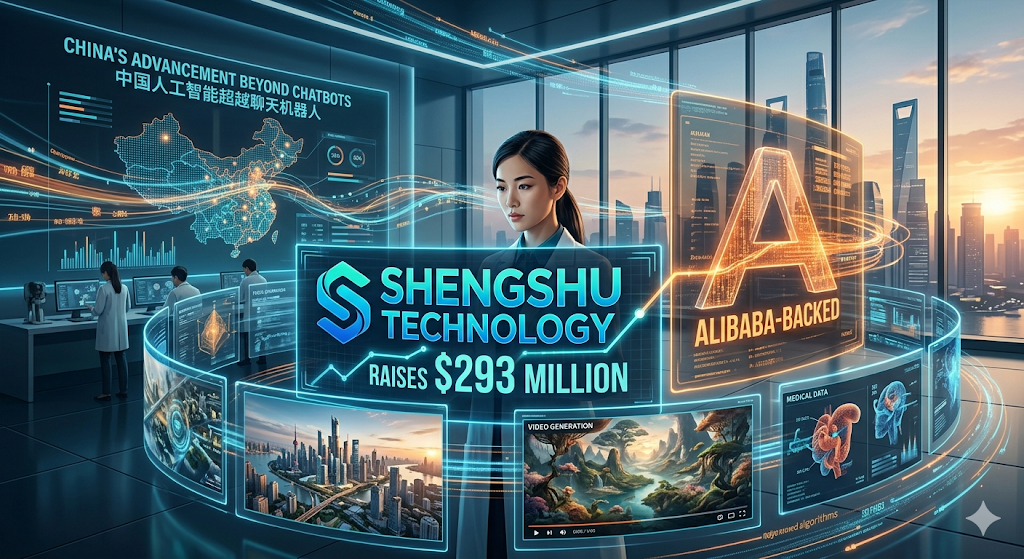
China’s artificial intelligence race is entering a new phase, and the latest signal came from ShengShu Technology after the startup secured 2 billion yuan, or roughly $293 million, in fresh funding led by Alibaba Cloud. The investment stands among the largest AI financing rounds in China this year, but the real significance goes far beyond the size of the deal. Investors are increasingly directing money toward companies attempting to build systems that can interpret movement, video, sound and physical interaction together rather than simply generating text responses like traditional chatbots.
ShengShu’s strategy reflects a wider transformation underway inside the global AI industry. Early excitement around conversational systems created a flood of companies focused on large language models capable of writing text, answering questions or generating code. That market has now become crowded. Technology firms are searching for the next leap in capability, and many researchers believe future breakthroughs will depend on “world models” — systems designed to understand how objects, environments and actions behave in the real world.
The company says its long-term goal is to build a general world model capable of processing multiple forms of information simultaneously, closer to how humans combine sight, sound and spatial awareness. This matters because machines operating in factories, autonomous vehicles or robotics environments cannot rely only on text-based reasoning. They must interpret physical movement, environmental change and timing in real time. Investors increasingly see this area as one of the most commercially valuable directions for artificial intelligence.
ShengShu was founded in 2023 by researcher Zhu Jun, who previously worked in advanced AI research linked to Tsinghua University. The startup first gained attention after launching Vidu, a text-to-video generation platform developed during a period when global competition around AI-generated media accelerated rapidly. At the time, companies across the United States, China and Europe were racing to improve video realism, motion quality and scene consistency, areas considered technically more difficult than static image generation.
Vidu’s upgrades helped position ShengShu inside a highly competitive segment where performance improvements are closely watched by investors and researchers. Generating realistic video requires artificial intelligence systems to maintain visual continuity across multiple frames while understanding movement, perspective and timing. That challenge is one reason video-generation models are increasingly viewed as important benchmarks for broader multimodal intelligence rather than entertainment tools alone.
The company’s ambitions expanded further in late 2025 when it introduced Motus, an open-source multimodal model focused on robotic movement and interaction tasks. That move suggested ShengShu was aiming beyond consumer AI applications and toward systems capable of supporting machines operating in dynamic physical environments. In practical terms, the company appears to be positioning itself at the intersection of generative AI, robotics and industrial automation.
This shift is happening at a crucial moment for China’s technology sector. Chinese firms are facing growing pressure to demonstrate original innovation instead of producing local versions of already popular Western chatbot products. Investors are becoming more selective, rewarding companies that control important infrastructure, specialized models or scalable industrial applications. Funding decisions increasingly depend on whether startups can create systems useful for manufacturing, logistics, robotics or enterprise-level automation rather than short-term consumer hype.
Competition remains intense. Major Chinese technology groups including Alibaba, ByteDance and Kuaishou are investing heavily in multimodal artificial intelligence and AI-generated video systems. International rivals are moving quickly as well, especially in the United States, where companies continue advancing large-scale video and robotics-related AI models. Speed alone is no longer enough. Companies must now balance technical quality, computing efficiency and commercial deployment at the same time.
One important detail often overlooked in public discussion is the enormous computing requirement behind these systems. Training multimodal models capable of understanding video, motion and physical interaction consumes far more processing power than many standard language systems. This creates another strategic layer to the competition because companies with strong cloud infrastructure partnerships gain significant advantages. Alibaba Cloud’s involvement in ShengShu’s funding round therefore carries both financial and technical importance.
For ordinary users, these developments may initially appear limited to futuristic robotics or AI-generated media. Yet multimodal systems could eventually influence warehouse automation, medical imaging, autonomous transport, industrial safety systems and even household robotics. The long-term impact may extend far beyond chatbots and content creation tools that currently dominate public conversation around artificial intelligence.
The funding round also reflects a broader global reality: artificial intelligence is no longer being treated solely as a software industry trend. Governments, investors and technology companies increasingly view advanced AI systems as strategic infrastructure with economic and geopolitical implications. Nations capable of building scalable real-world machine intelligence may gain advantages across manufacturing, defense, logistics and scientific research.
If ShengShu succeeds in developing a reliable world-model architecture, the company could emerge as a serious player in the next stage of artificial intelligence development. That future will likely depend less on machines generating clever text responses and more on whether they can safely understand and interact with the physical world itself.
About the Author
Ashutosh Raj is a journalist and independent writer known for clear, fact-based reporting and sharp editorial judgment. His work focuses on delivering accurate information with original analysis, structured storytelling, and strong attention to credibility. He writes with a commitment to clarity, relevance, and meaningful public understanding.
About the Author